What you are learning
International Morse code has 26 letters, 10 numbers and a handful of punctuation marks. Each is a short pattern of two sounds: a short one, the Dot, and a long one, the Dash. Radio operators call them "dit" and "dah", which is a good hint about how to think of them: as sounds, not as dots on paper.
Start with the letters. Numbers follow a simple rule and come quickly once the letters are in place. The full chart
Learn by sound, not by sight
The advice you will hear most from experienced operators: learn each character as a sound.
- When you hear a letter, you should recognize its rhythm as a whole, the way you recognize a word. Counting "Dot, Dash, Dot" works at first but holds you back later.
- Visual tricks and mnemonics can get you started, but they add a step between hearing and knowing. Many learners find they have to unlearn them to go faster.
- Charts and trees are good for understanding how the code fits together. Practice by ear.
Tip: cover the chart. Play a letter in the translator, say what you heard, then look.
Short daily sessions
Most teachers suggest a few minutes every day rather than one long session a week. Short sessions are easier to fit in and easier to keep up. There is no set number of days that works for everyone; people learn at very different speeds. Steady practice is what counts.
Methods: Koch and Farnsworth
Two methods show up in nearly every course.
The Koch method. Developed by the German psychologist Ludwig Koch in the 1930s. You start with just two characters at full speed, around 15 to 20 words per minute. When you can copy them with about 90 percent accuracy, you add one more. Because the characters are fast from the start, you learn them as sounds, not as patterns to count.
Farnsworth timing. Each character is sent at a fast speed, but the gaps between characters and words are stretched. You hear the true rhythm of each letter, with time to think between them. As you improve, the gaps shrink.
The two combine well: fast characters (Koch), with extra space between them (Farnsworth), and the space reduced as you go. Speed and Farnsworth timing
A sensible first week
A generic plan. Go at your own pace and move on when a set feels easy.
- E and T: one Dot, one Dash.
- Add A, N, I and M.
- Add S and O. Now you can read SOS.
- Add R, K, D and U.
- Add W, G and H.
- Review all of them, and read short words made from them.
- Rest, or a light review.

Morse Keyboard: a keyboard laid out as the Morse code tree, with a course of a weekend and four weeks. Day 1 is free. For iPhone and iPad.
Safety. In an emergency, call your local emergency number (for example 112 or 911). A phone light or speaker sending Morse is not a substitute for calling for help.
Practice sending as well as receiving
Copying Morse by ear is only half of it. Sending, by tapping, keying or typing, makes the patterns stick from the other side. Tap a rhythm on a table, use a key or a phone app, and check what you send against a translator.
Where Morse Keyboard fits
Morse Keyboard is our app for iPhone and iPad. Its keyboard is laid out as the Morse code tree, so every message you type is practice: you see the Dots and Dashes of each word as you go. A short course comes with it, a weekend and four weeks of short sessions, with sound, reading, keying and typing in every lesson. Day 1 is free. How it works
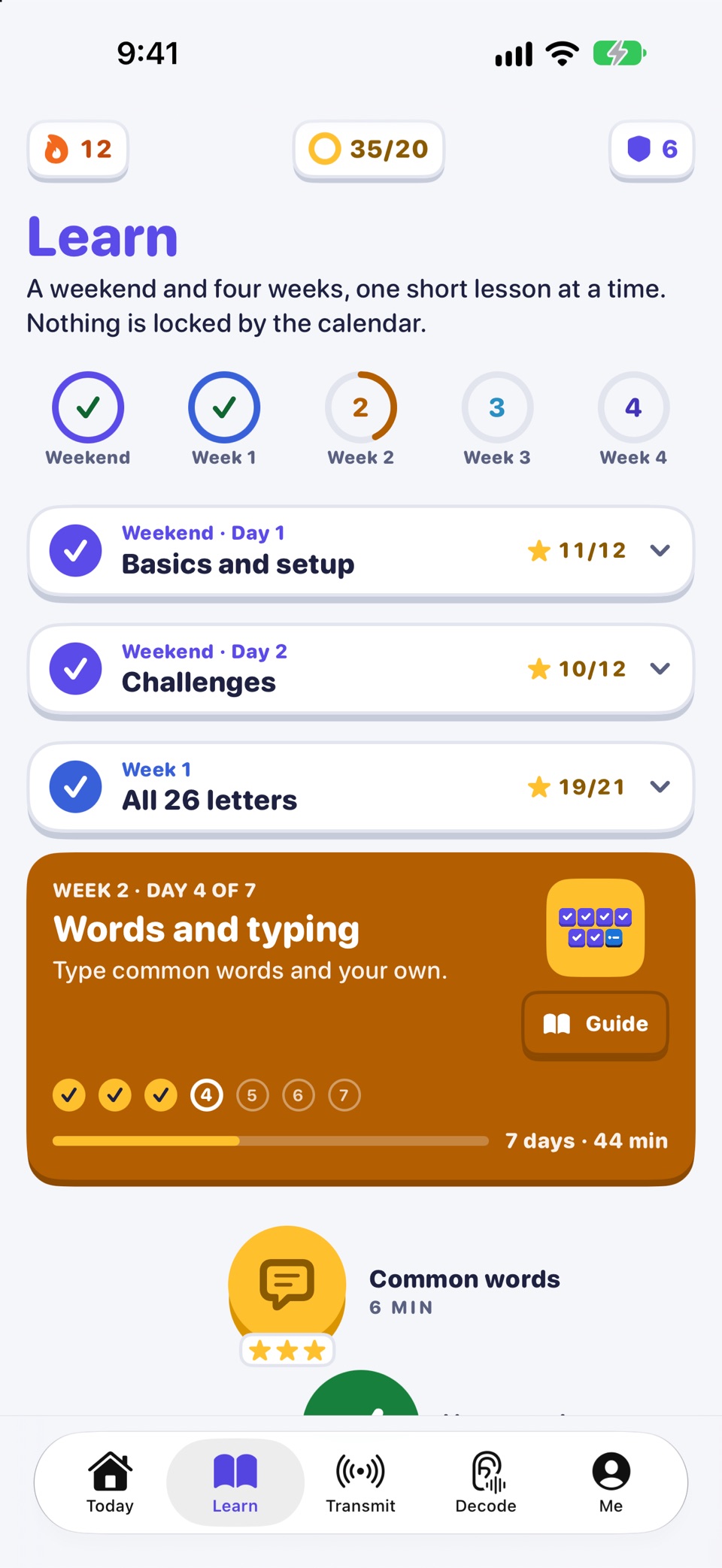
The course: a weekend and four weeks 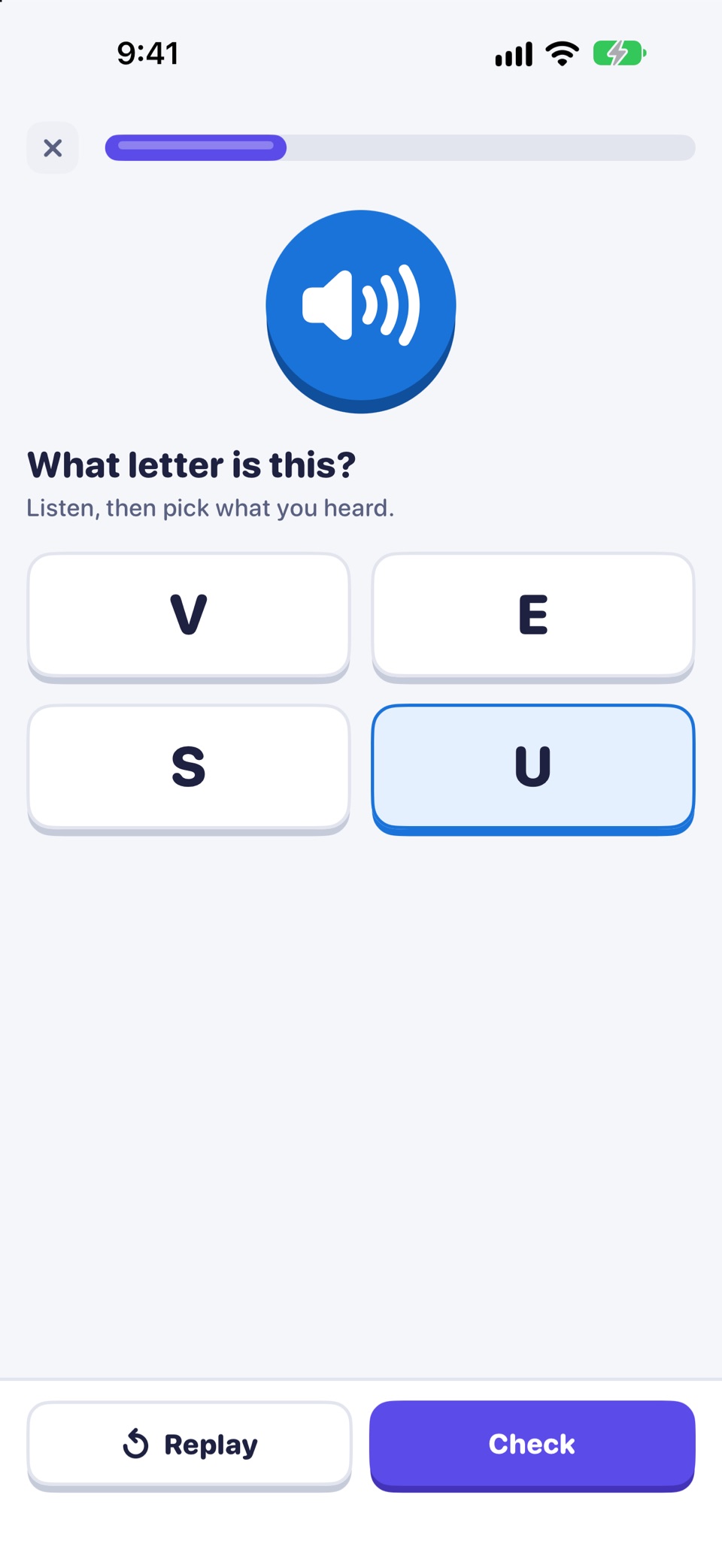
Each lesson starts by ear
Other good free resources
- ARRL: Learning Morse Code: the US national amateur radio association's page of methods and tools.
- LCWO.net: free online Koch course and practice in your browser.
- G4FON Koch trainer: a long-standing Koch method trainer for Windows.
- CWops CW Academy: free, structured online classes with volunteer advisors.
- W1AW code practice: ARRL's station sends code practice on the air at several speeds.
Morse code and ham radio
In the United States, the FCC dropped the Morse code test for amateur radio licences in 2007. Many other countries have done the same. Morse, often called CW (continuous wave) on the air, is still widely used by radio amateurs: it gets through when signals are weak, and the gear is simple.
To read ham radio shorthand such as CQ, 73 and QTH, see abbreviations and prosigns.
Morse Keyboard: a keyboard laid out as the Morse code tree, with a course of a weekend and four weeks. Day 1 is free. For iPhone and iPad.