Free printable chart
Morse code alphabet chart
The International Morse code alphabet, as set by the ITU. Press a letter's play button to hear it. To print the chart on one page, use the Print button.
R is .-.Dot Dash Dot
The chart
Letters A to Z
Tap a key to hear it, see it on the tree and look it up in the card above.
See whole words and phrases in Morse code examples.
Five marks each
Numbers 0 to 9
Every number has five marks.
| Number | Morse | Marks |
|---|---|---|
| 1 | .---- | Dot Dash Dash Dash Dash |
| 2 | ..--- | Dot Dot Dash Dash Dash |
| 3 | ...-- | Dot Dot Dot Dash Dash |
| 4 | ....- | Dot Dot Dot Dot Dash |
| 5 | ..... | Dot Dot Dot Dot Dot |
| 6 | -.... | Dash Dot Dot Dot Dot |
| 7 | --... | Dash Dash Dot Dot Dot |
| 8 | ---.. | Dash Dash Dash Dot Dot |
| 9 | ----. | Dash Dash Dash Dash Dot |
| 0 | ----- | Dash Dash Dash Dash Dash |
Signs and symbols
Punctuation and symbols
Signs marked "Common, not ITU" are widely used but are not in the ITU standard.
| Sign | Character | Morse | Standard |
|---|---|---|---|
| Full stop (period) | . | .-.-.- | ITU |
| Comma | , | --..-- | ITU |
| Colon | : | ---... | ITU |
| Question mark | ? | ..--.. | ITU |
| Apostrophe | ' | .----. | ITU |
| Hyphen or minus | - | -....- | ITU |
| Slash (fraction bar) | / | -..-. | ITU |
| Open bracket | ( | -.--. | ITU |
| Close bracket | ) | -.--.- | ITU |
| Quotation mark | " | .-..-. | ITU |
| Double hyphen (=) | = | -...- | ITU |
| Cross or plus (+) | + | .-.-. | ITU |
| At sign (@) | @ | .--.-. | ITU |
| Exclamation mark | ! | -.-.-- | Common, not ITU |
| Ampersand (&) | & | .-... | Common, not ITU |
| Semicolon | ; | -.-.-. | Common, not ITU |
| Underscore | _ | ..--.- | Common, not ITU |
| Dollar sign | $ | ...-..- | Common, not ITU |

Morse Keyboard: a keyboard laid out as the Morse code tree, with a course of a weekend and four weeks. Day 1 is free. For iPhone and iPad.

Print this chart
The Print button gives you the letters, numbers and punctuation on one A4 or Letter page, in black on white. Pin it by your desk, or keep it in a notebook while you learn.
Another way to read it
Reading the chart as a tree
The same letters can be drawn as a tree. Start at the top. A Dot takes you left and a Dash takes you right. E and T sit one step down, I, A, N and M two steps, and so on. Letters that start the same way share a branch, which makes the alphabet easier to remember.
RDot Dash Dot: from the space bar, left, then right, then left.
Using the chart
Tips for learning the alphabet
- Learn the sound, not the picture. Operators learn each letter as one rhythm. Hear it as a whole rather than counting marks.
- Start with a few letters. E, T, I, A, N and M are short and easy to tell apart.
- Practice a little every day. Short sessions are easier to keep up than long ones.
A short history
A short history
Samuel Morse and Alfred Vail developed an electric telegraph code in the United States in the 1830s and 1840s. In 1844 the first message went over a public line from Washington to Baltimore.
Their American code used gaps of different lengths inside some letters, which was hard to send cleanly. In 1848 Friedrich Clemens Gerke simplified it for telegraph lines in Germany. That version, adopted across central Europe from 1851 and agreed at an international telegraph conference in Paris in 1865, became International Morse code.
Today the International Telecommunication Union (ITU) publishes it as Recommendation ITU-R M.1677-1. The patterns on this page follow it.
Morse Keyboard: a keyboard laid out as the Morse code tree, with a course of a weekend and four weeks. Day 1 is free. For iPhone and iPad.



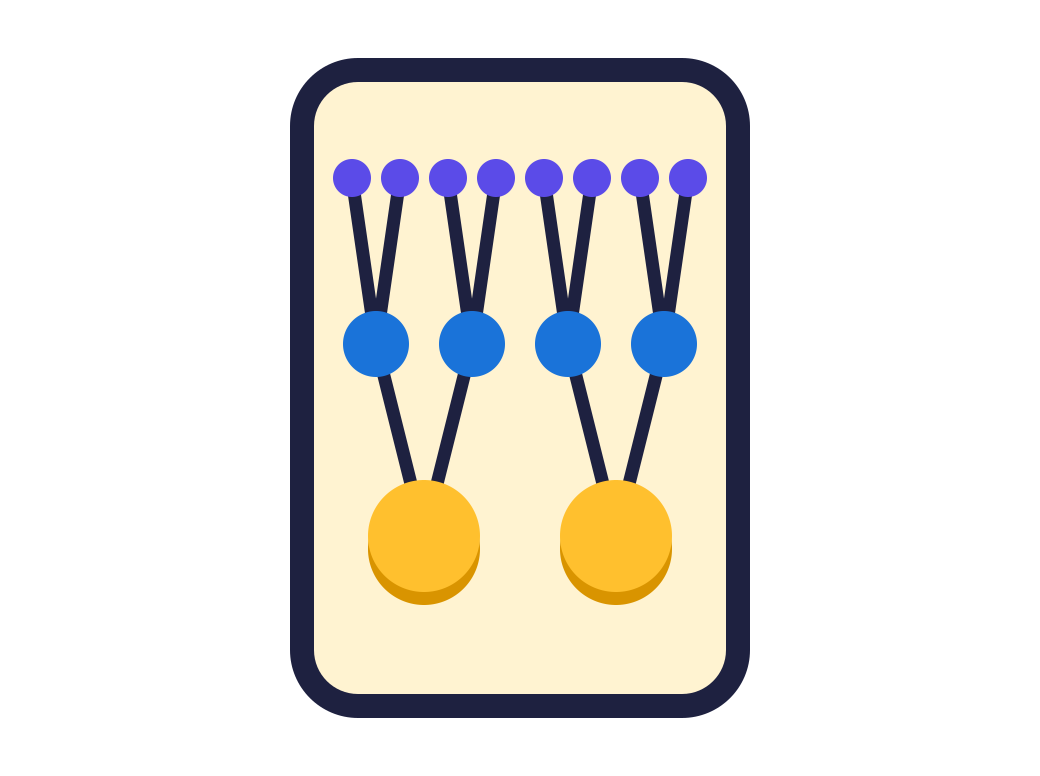
Learn the letters on a keyboard shaped like the tree.
A keyboard laid out as the Morse code tree, with a course of a weekend and four weeks. Day 1 is free.