The distress signal
SOS in Morse code
Safety. In an emergency, call your local emergency number (for example 112 or 911). A phone light or speaker sending Morse is not a substitute for calling for help.
The SOS pattern
SOS in Morse code is three Dots, three Dashes and three Dots:
...---...
It is sent as one continuous signal, with no gaps between the letters. That makes it a
prosign: a signal of its own, not the three letters S, O and S spelled out. You will often see
it written as ... --- ... because that is easier to read, and listeners will recognize either.
Flashing light. Flash turns the circle on and off quickly. If flashing light can affect you, do not use it.
What it means
What SOS means
SOS does not stand for "save our souls" or "save our ship". Those phrases came later. The pattern was chosen because it is easy to send and hard to mistake: three short, three long, three short, with nothing else like it.
It was agreed at the International Radiotelegraph Convention in Berlin in 1906 and came into force on July 1, 1908. Before that, ships used other calls, such as CQD, used by Marconi company operators.
With light and sound
SOS with light and sound
SOS can be sent with any on-and-off signal: a tone, a whistle, a flashlight, a mirror.
- Keep the rhythm steady. The Dashes should be clearly longer than the Dots, about three times as long.
- Leave a long pause, at least as long as seven Dots, before you repeat the signal.
- A slow, clear signal is easier to recognize than a fast one.
Safety. In an emergency, call your local emergency number (for example 112 or 911). A phone light or speaker sending Morse is not a substitute for calling for help.
By voice
Mayday and other distress signals
On voice radio, the distress call is "Mayday", said three times. It comes from the French "m'aider" ("help me") and was adopted for radiotelephony in the 1920s. "Pan-pan" signals an urgent problem that is not yet life-threatening. Mayday in Morse code
Today, ships and aircraft rely on modern systems such as the GMDSS (Global Maritime Distress and Safety System), satellite beacons and digital calling. SOS in Morse code is still widely recognized.
In the app
Morse Keyboard and SOS
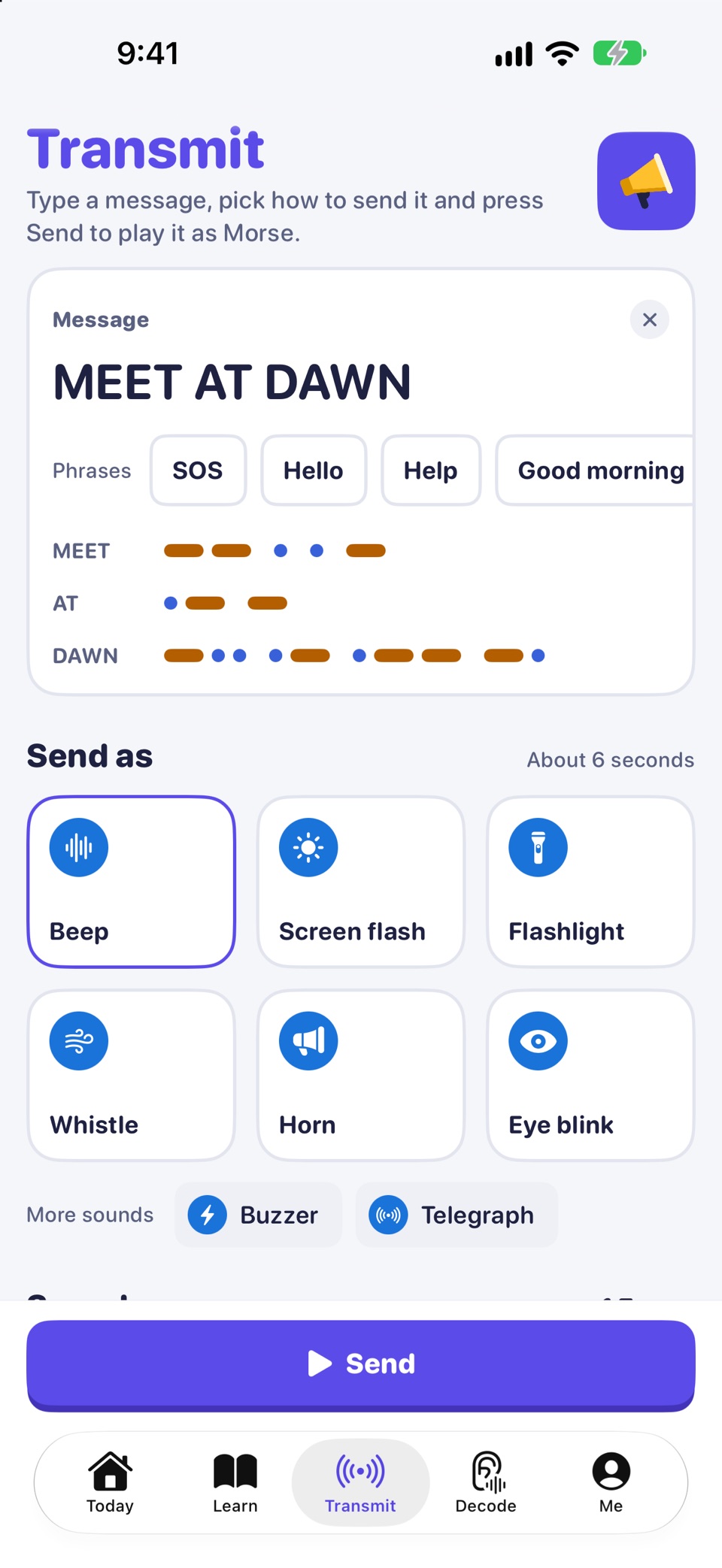
SOS is part of Day 1 of the course in Morse Keyboard, which is free. The app's Transmit screen can send it as beeps or a screen flash, free, or with the flashlight on iPhone with Pro. It is for learning and practice.
Safety. In an emergency, call your local emergency number (for example 112 or 911). A phone light or speaker sending Morse is not a substitute for calling for help.
Morse Keyboard: a keyboard laid out as the Morse code tree, with a course of a weekend and four weeks. Day 1 is free. For iPhone and iPad.
Morse code translator · Alphabet chart · Transmit in the app · Emergency signals in Morse code · Help in Morse code
Learn SOS on Day 1. It is free.
A keyboard laid out as the Morse code tree, with a course of a weekend and four weeks. Day 1 is free.